WANIT delivers an innovative solution: the SolarConnector paired with the TWIN water heater
Solar panels: stay profitable through household self-consumption
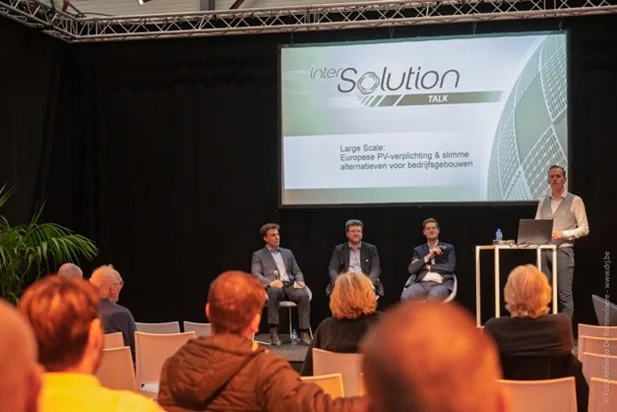
At Solar XPO (24, 25 and 26 May), the first trade fair in Wallonia dedicated to solutions and innovations in renewable energy, Belgian start-up WANIT will demonstrate that using 100% of the solar energy generated by households is the most sustainable and profitable option.
Without subsidy schemes, which are disappearing across the country’s three Regions[1], and without substantial, or even total, self-consumption, residential photovoltaic installations are becoming less and less profitable.
Against this backdrop, Brussels-based start-up WANIT has designed and developed an ‘out of the box’ solution: energy generated by household photovoltaic panels is stored first as domestic hot water, with any surplus stored in a small battery. This system is far more economical and profitable than traditional storage solutions because its built-in intelligence promotes 100% self-consumption. At the most recent Batibouw, WANIT won the Product Innovation trophy for this innovation, awarded by the Belgian Building Awards jury, a welcome endorsement from the construction industry.
Profitability in freefall
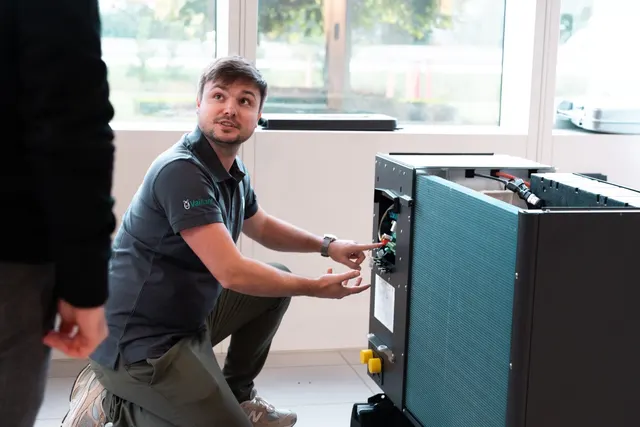
At the heart of WANIT’s solution is a charge and heating controller (MPPT in industry parlance), called the SolarConnector, and a connected water heater (TWIN). They communicate to optimise self-consumption of the solar energy generated. Requiring fewer solar panels (between 2 and 6) and taking up little space, the system is particularly well suited to older buildings, often singled out as terrible ‘energy sieves’.
‘Conventional photovoltaic systems are very often oversized. The simultaneity between electricity generation and consumption is around 30%, which means that a significant proportion of household solar energy has to be fed back into the grid instead of being used directly by the person who generates it,’ explains Christian Bayet, founder and CEO of WANIT.
It is also worth noting that, in early 2024, all electricity suppliers reduced the feed-in tariff for conventional photovoltaic installations (or prosumers), which is currently around 3 euro cents per kWh, almost ten times less than the price households pay for electricity.
€800 to €1,000 in savings per year
WANIT’s solution enables households to use up to 100% of the solar energy they generate: first to produce domestic hot water, then to meet some of their household electricity needs, with a compact battery (3 to 5kWh). The estimated savings on the energy bill for an average household are around €800 to €1,000 per year. Given the relatively low cost of the investment[2], the system pays for itself in five to six years, depending on the configuration.
‘WANIT is showing that the photovoltaic sector can still be profitable if we think and act differently,’ says Claudio Bucella, who is responsible for Business Development. ‘That is the positive message we want to put across at the Beprosumer non-profit’s general meeting, which will take place during Solar XPO at WEX in Marche-en-Famenne. Attitudes need to change. Explain to me why, in the Brussels-Capital Region, our sustainable system receives no subsidy on the grounds that the photovoltaic energy generated is not fed back into the grid, when, I would remind you, doing so places a burden on the distribution network, which has to be reinforced at a cost ultimately borne by consumers. It makes no economic sense!’
Expansion and fundraising
At the end of 2023, WANIT raised funds from investors close to the company (the traditional FFF, or Family, Friends & Fools), marking the first step in securing the capital needed for its development. The company is currently expanding its installer network in Wallonia and Brussels, and also plans to enter the Flemish market in the second half of 2024.
WANIT was also a winner of Innoviris’s Innovation Starters Awards, which funds R&D at Brussels-based technology start-ups. This support will enable WANIT to carry out its three-year research programme and develop its next product, which will turn an existing sanitary installation into a profitable renewable self-consumption system, complementing the range of solutions already on offer.
[1] The principle of the ‘spinning backwards’ meter, already abolished in Flanders and Brussels in 2021, was also abolished in Wallonia on 1st January 2024. There is therefore no longer any prosumer tariff compensation scheme anywhere in Belgium. Green certificates have also been phased out, except in the Brussels-Capital Region, where they now trade at the lowest price because of an imbalance between electricity supply and demand.
[2] A standard installation with two photovoltaic panels costs around €4,500 (excluding the cost of a battery to store the surplus).
Question about this story? Ask your question
Keep following this
Get an email when a new story is published. No account needed.
- ThemeGenerating and managing energy
- SubjectNews