











The future of residential photovoltaics in Wallonia
Last May, Techlink surveyed its Walloon members who install residential photovoltaic (PV) systems. The survey covered several topics: installer profiles in 2021, sales trends over the previous two years, smart meters and future prospects. Read on for the key findings.
Residential PV installer profiles
The survey first sheds light on the profile of residential PV installers today. All respondents have been active in photovoltaics since 2008-2009, with just two exceptions, one since 2007 and the other since 2010. This coincides with the introduction of the Solwatt plan in 2008, which marked the real beginning of interest in photovoltaics in Wallonia. The survey participants are therefore all ‘old hands’ who have weathered the sector’s various changes over the past 13 years.
In the vast majority of cases, installers active in residential PV do not install commercial-scale systems, or do so only to a very limited extent. In addition, most respondents say they have activities outside photovoltaic installation. Among these, installing charging points for electric vehicles is the most common, cited by 2/3 of respondents, followed by general, commercial and industrial electrical services, and HVAC systems, particularly heat pumps and air conditioning. The ‘PV-only’ business model therefore no longer accounts for most of the installation market.
Observations on the 2019-2021 period
Compared with 2019, most installers did not see their PV sales grow in 2020. The main reasons cited were regulatory uncertainty, particularly the prosumer tariff, followed by the impact of Covid. However, many participants saw sales grow in the 1st quarter of 2021, even though the payback periods quoted were broadly similar to the previous year, at an average of 7 years. The reasons given for this recovery after a subdued 2020 included high electricity prices and increased residential electricity needs, such as heat pumps and electric vehicles.
Two thirds of respondents advise their residential customers not to have their electricity meter replaced with a smart meter. They say they still need greater clarity on the issue and are cautious by default. Several respondents also point to the importance of self-consumption, energy storage systems and charging points as natural incentives that could persuade households to have their meters replaced in future.
Future prospects
Without any significant change, many installers expect future PV sales to decline, initially at a slow rate until 2023, then more sharply from 2024 onwards. This is due to PV’s gradually declining financial appeal, as the system of the meter running backwards comes to an end and the prosumer tariff takes effect. There are also concerns that the market could shift away from electricians and electrical engineering SMEs towards larger players, such as contractors and energy suppliers.
Respondents spontaneously say that the sector needs long-term stability. The industry also calls for standards of quality in the trade to be maintained, for example through quality requirements covering equipment, installation work and on-site safety rules, as well as the quality of information provided to households. The results also show that choosing PV is increasingly less about a simple ‘opportunistic’ financial investment and more clearly driven by the need for PV as a solution to practical energy management challenges.

In conclusion
Despite these warnings from the sector, the results point to encouraging signs for the long-term viability of residential PV. In practical terms, the recovery in PV system sales in early 2021 is explained in part by households’ desire to protect themselves against rising electricity costs. PV is also being considered as a way to manage consumption peaks that may result from equipment in homes that significantly changes household electricity consumption patterns, such as heat pumps and electric vehicles. Some of the comments on smart meters point in the same direction: changes in household consumption patterns could be enough to persuade some households to have their meters replaced in future. Even without the meter running backwards, photovoltaics remain economically attractive.
Techlink has always advocated a holistic approach to supporting the energy transition. For legislators, this means avoiding the easy option of introducing short-term subsidies as an incentive for societal behaviour change. Techlink encourages the various ministerial offices and administrations to continue consulting and involving those working closest to the ground in decision-making, and to communicate with them regularly.
Belgian Solar Day
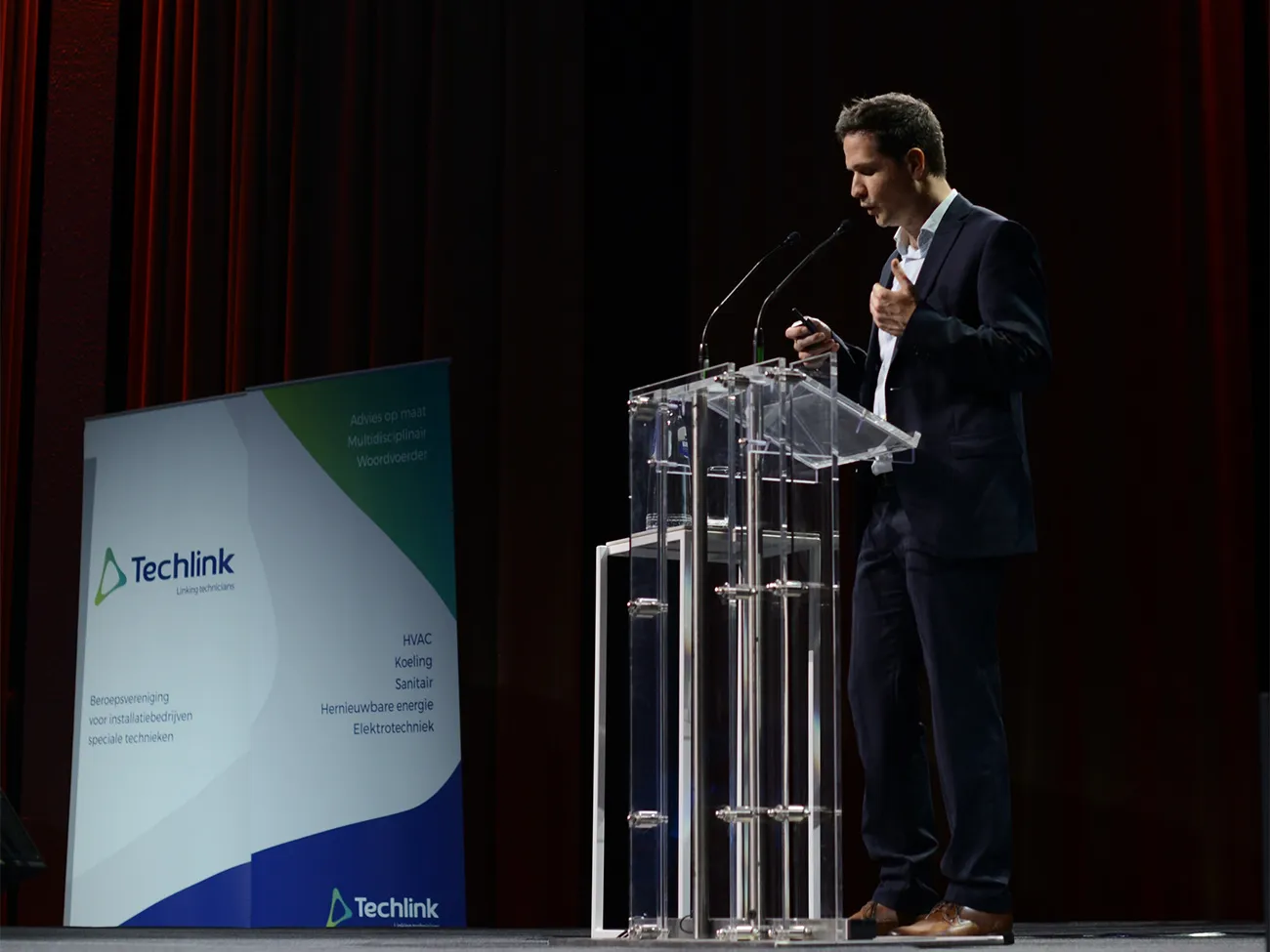
Renewable energy federations Edora and ODE, Becquerel Institute and Techlink organised the third edition of Belgian Solar Day on 15 September. A total of 250 people, including experts, industry representatives and political leaders, attended the photovoltaic sector’s major annual event! Arnaud Etienne, Sector Manager Renewables at Techlink: “2020 was a great year for photovoltaic installations in Belgium’s 3 Regions. Continued growth in PV capacity is essential if Belgium is to meet its climate commitments by 2030. Alongside this quantified national target, PV also plays a key role in the energy transition today. A PV system works extremely well in combination with the arrival of home energy management systems (CEMS), the mass roll-out of electric vehicles and their charging points, energy communities, capacity tariffs, and so on. All these major developments happening at the same time present real challenges for electricians and electrical engineering companies. After all, installers are the first people customers turn to when trying to make sense of all the changes currently taking place in their energy supply. This is also one of the main findings of the LINK2030 study, conducted in part by Techlink on the future of our sector: the citizen’s energy landscape will continue to grow more complex in the coming years. Techlink therefore considers it important to support our members through all these changes, so they can seize every opportunity presented by the energy transition.”
Question about this story? Ask your question
Keep following this
Get an email when a new story is published. No account needed.
- ThemeGenerating and managing energy
- SubjectNews







