











The SRI catalogue: a useful checklist
Gradually integrating intelligence into buildings
If you want to make a building ‘smart’, it is best to make that decision during the design phase of your construction or renovation project. However, technology can also be integrated gradually. This approach does, however, require a precise inventory of the options and a considered choice of priorities. Unfortunately, there is still no checklist that applies to every situation. The catalogue of smart services used by the SRI (Smart Readiness Indicator) could offer a useful solution. At least, that is one of the conclusions of an analysis carried out at the Galilée building in Brussels.
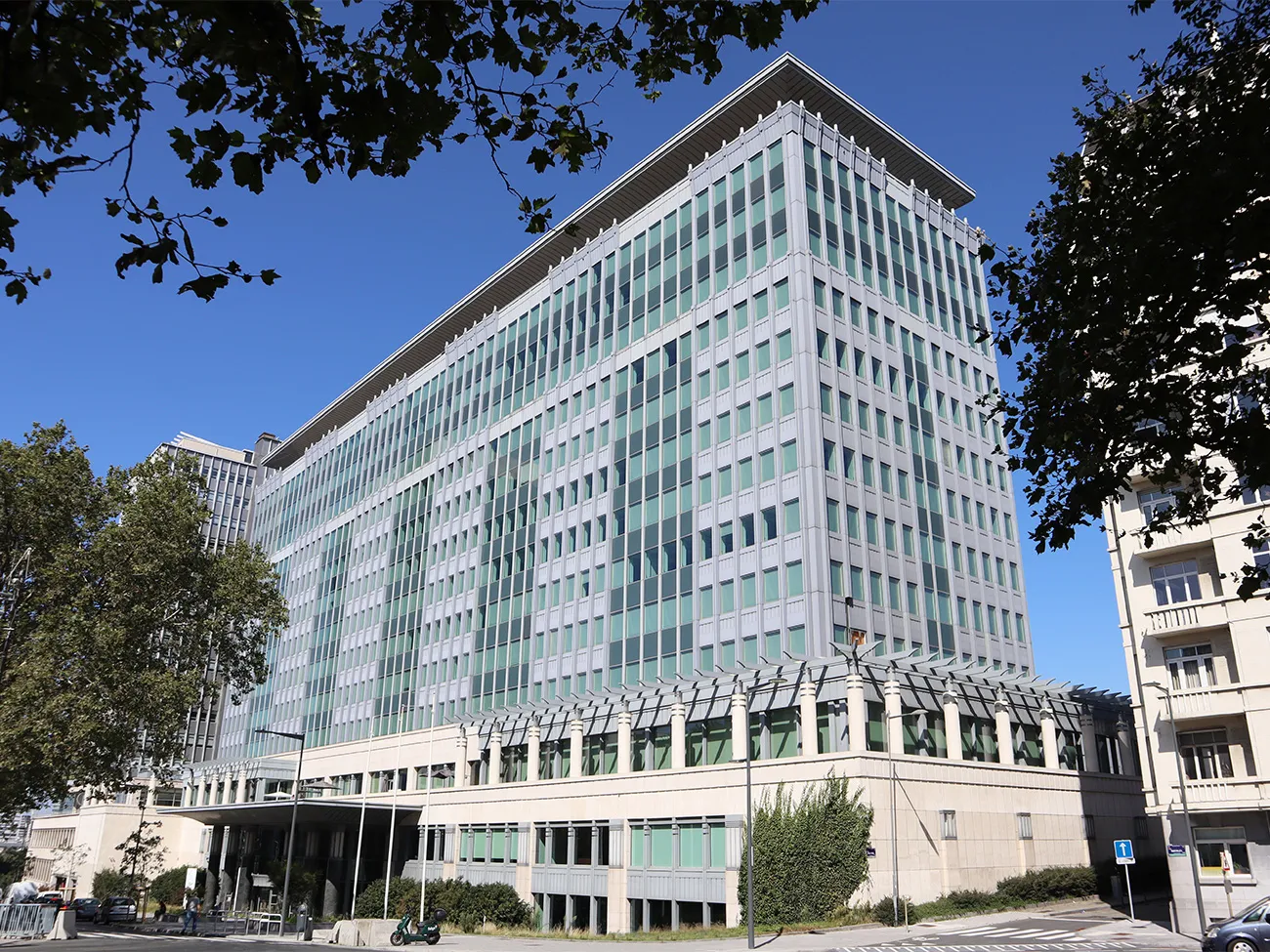
At the initiative of former federal Minister for Public Health Maggie De Block, it was decided to merge several health sector administrations. “A genuine strategic plan was drawn up, and the first step was to find a suitable building,” says Koen Mees, CEO of Freestone, a service provider with expertise in real estate, construction, PropTech and facility management, which supported the process. “The Galilée building was ultimately selected. The building had already undergone extensive renovation in 2001, but still needed a major refurbishment to accommodate the three administrations.”
The importance of smart technology in optimising operations
Bringing three administrations together under one roof requires integration and optimisation. Koen Mees says: “Following the merger, all support activities, including facility management tasks, had to be entrusted to a single team. This exercise also provided an opportunity to review and adapt these activities at the same time. We also looked at how to optimise the use of space through flexible workstations. To maximise comfort, we eventually realised that the building needed a certain level of intelligence. Tomorrow’s office complex will indeed use integrated workplace management solutions (IWMS). The ideal scenario is for this approach to be powered by data from both users and the building, which will also be the case at the Galilée building.”
An analysis was needed
However, it was only once the refurbishment work was well under way that management decided to explore the potential of ‘smart buildings’. “This is obviously not the ideal stage to do so. Ideally, it should be done at the start of a project,” says Koen Mees. “That said, the time has not been wasted. On the contrary, experience has taught us that there is plenty that can still be improved easily in projects like this. Small additional investments can generate significant added value, provided the options are clearly understood and areas for improvement identified. That is why we have been working for many years with Ingenium, a consultancy specialising, among other things, in building and systems audits.”
A practical tool called SRI
Ingenium’s audit covered the building and its technical systems, as well as the user. “Nowadays, it makes sense for a building to adapt to each user’s specific comfort requirements,” explains Wim Boone, engineer and business development director at Ingenium. “The ‘one size fits all’ principle is well and truly a thing of the past.
Heating, cooling, lighting and other systems need to be customisable to a certain extent, but this must go hand in hand with a high level of energy efficiency and comply with the strict legislation in force in Brussels. There is no global definition of a ‘smart building’. It all depends on requirements, budget, building type and so on. Fortunately, a tool such as the SRI can help make informed choices. In our view, the catalogue of smart services on which the indicator is based is a useful source of inspiration for identifying measures that could make a building smarter.”
How does the SRI work?
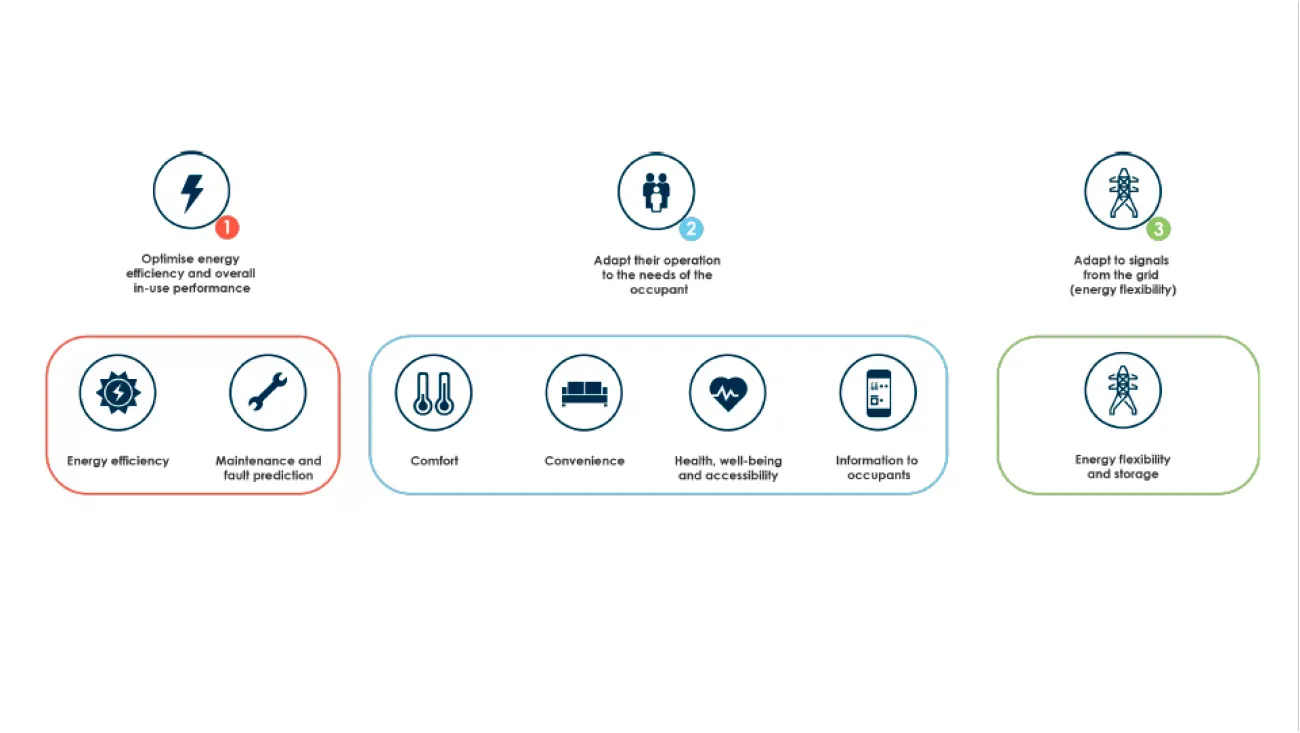
The SRI is based on three principles: optimising energy efficiency, enabling the building to meet users’ needs, and responding to signals from the grid. Wim Boone explains: “The SRI closely reflects the priority areas associated with ‘smart buildings’: ‘comfort & convenience’ (the ability to meet users’ needs), ‘energy efficiency performance & operations’ (the intelligent management and use of energy and resources) and, finally, ‘energy flexibility’ (the ability to manage energy demand and store energy).”
The SRI uses a method that assigns a functionality score to services across nine domains, including heating, cooling and lighting. The functionality levels achieved can then be used to create an ‘impact, domain’ matrix for seven different impact criteria, including energy efficiency, comfort and energy flexibility. “The value of this matrix is that it clearly shows how a higher level of (smart) functionality can be achieved for each service,” explains Wim Boone.
“Take this example: instead of heating an entire building from 7 to 17 h, it is possible to heat only the areas where people will actually be working, by installing an occupancy detection system or checking their calendars. The ‘impact, domain’ matrix then provides a baseline list of opportunities for improvement. Data play a central role here: how can data from systems, users, external networks and so on be used to create a healthier, safer and more comfortable working environment?”
A wealth of possibilities
For the Galilée building, Ingenium drew on the SRI method’s service catalogue to identify potential improvements. The analysis clearly showed that a great deal could be improved without major investment. This made it possible to target measures to increase the building’s level of intelligence within a limited budget. “We set about calculating the return on investment for each of these measures,” says Wim Boone. “That is not very difficult for measures designed to save energy, but it is a different matter when it comes to improving comfort, which is much harder to quantify.” “In that case, you have to convince the client by listing tangible benefits,” adds Koen Mees. “Greater productivity, less sickness absence, more creativity, and so on.” Ingenium’s action plan clearly distinguished between short-term and long-term investments. “Making a building ‘smart’ is a process that can indeed be carried out step by step,” says Wim Boone. “Our analysis of the Galilée building shows that many aspects can be improved without spending a fortune.”
A pilot project with additional sensors
The analysis brought Ingenium and Freestone to management’s attention. For budgetary reasons, investments will be made gradually. “There is, however, a strong commitment to making the building smart, as shown by a recent pilot in which additional sensors were installed in a number of office spaces,” says Koen Mees. “The aim is to explore how occupancy can be linked to smart air-conditioning and cleaning systems. Initially, collecting and interpreting the data is central. How often were booked meeting rooms actually used? Was there an increase in CO2 levels, and/or when were maximum values exceeded? Was the desired temperature reached while visitors were present? These are all questions we want to answer by analysing the data. In this way, we aim to demonstrate that this additional intelligence does deliver added value and can, for example, enable a predictive system for room air conditioning.”
The importance of interconnectivity
It remains to be seen, of course, whether the Galilée building will become a truly smart building. “That is certainly management’s intention,” says Koen Mees. “It is important to take a holistic view and remember that there are technical and budgetary obstacles, particularly in renovation projects,” adds Wim Boone. “The result is that people generally focus on optimising individual ‘silos’: HVAC, lighting and so on. Yet the greatest financial and sustainability benefits come from an interconnected system that allows all installations to communicate with one another. Only then can you truly generate large volumes of data, and the insights derived from them, to take an innovative approach to sustainability, achieve optimum efficiency and create an office environment that puts comfort first.”
Question about this story? Ask your question
Keep following this
Get an email when a new story is published. No account needed.
- SubjectNews







