











ATTB becomes Climafed: much more than a new name
As climate change poses an increasingly serious challenge, the Association des techniques thermiques de Belgique (ATTB) has decided to reinvent itself. Under its new name, Climafed, with a completely revamped organisational structure and a sharper focus on its mission, the Belgian Federation of Climate Technologies aims to send a strong signal to its members and stakeholders about its commitment to shaping a sustainable and resilient future.
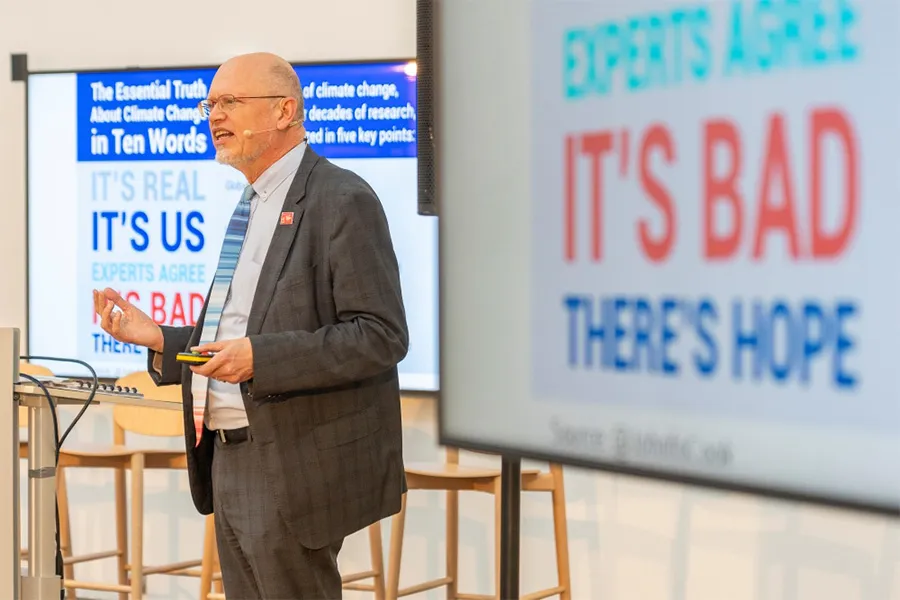
From ATTB to Climafed
The Association pour les techniques thermiques en Belgique (ATTB) was established in 1973 as an association of boiler manufacturers. Over time, manufacturers and importers of renewable heating systems also joined the network, as did companies offering related products or services. What began as an initiative to collect market data has become a platform for informing and representing the entire sector. Today’s launch of the new name, corporate identity and website, under the name Climafed, Belgian Federation of Climate Technologies, is much more than a cosmetic update. It symbolises the organisation’s vital position and mission within the Belgian heating market. It is the result of an extensive process of self-reflection and renewal, driven by urgent climate challenges.
Climate challenges and European policy
In a world experiencing rapid climate change, with global warming at the forefront, urgent action is needed, alongside a long-term vision. Climate technologies play a crucial role, since heating and cooling account for 50% of energy consumption in Europe. Decarbonising these processes is essential to keep warming below 1.5 °C and prevent severe climate threats, as we are now close to that threshold.
European policy documents such as the European Green Deal aim to make the EU climate-neutral, with net-zero CO2 emissions by 2050. These provisions became legally binding when the European Parliament and Council adopted the Climate Law in 2021. The Fit for 55 package requires a 55% reduction in greenhouse gas emissions by 2030. Belgium has also committed to reducing greenhouse gas emissions by 47% by 2030 compared with 1990. We will soon also have to meet the targets for 2040, following the recent adoption of the European Energy Performance of Buildings Directive (EPBD). At local and regional level, these targets translate into specific measures for buildings. In short, Belgium must be able to heat and cool its buildings entirely without fossil fuels by 2050.
Although progress has been made, it has not yet been sufficient. Since 1990, combined emissions from residential and non-residential buildings have fallen by nearly 29% (from 25 068 kilotonnes of CO2 equivalent in 1990 to 17 992 in 2022), but there is a significant difference between the two sectors: while residential-sector emissions have fallen by 37.1%, emissions from the tertiary sector have risen by 14.5% (building heating). In addition, fuel consumption, particularly gas use, is rising steadily across our building stock. Between 1990 and 2022, fuel consumption in the residential sector increased by 17.4%, while the tertiary sector saw an increase of 30% since 1990.

Transformation and redefinition
ATTB has always played a leading role in promoting energy-efficient solutions and the transition to renewable sources. But as Climafed, the organisation has reinvented itself. It has not only adopted a new name, logo, identity and website, but also completely overhauled its organisational structure to reflect Climafed’s vision of its role in climate technology and the fight against climate change.
“To provide even better support to its members and stakeholders, Climafed now represents not only manufacturers and importers of energy-efficient heating and hot water solutions, but also cooling and ventilation solutions,” says Christophe Leroy, president of Climafed. “This enables us to offer multifunctional solutions to specific challenges, with the aim of reducing CO2 emissions at the lowest possible social cost.”
Climafed has also designed its new website, www.Climafed.be, so that its structure is no longer based on 5 sections for manufacturers, importers and companies, but instead on their specific project categories: “new residential construction and major energy renovations”, “residential replacements and renovations” and “collective and non-residential projects”.
The solutions on offer include not only sources of heating and cooling such as heat pumps, boilers, solar thermal systems, heating and cooling networks, and cogeneration systems, but also ventilation, hydraulics, measuring equipment, services and support. They are mainly divided into three specific fields of application to enable a more targeted approach.
“This change in segmentation goes beyond a simple website update. It represents the essence of Climafed’s new operational organisation and how it presents itself to the outside world,” stresses Christophe Leroy.

“The same applies to the various position statements now featured on Climafed’s new website,” says Patrick O, public affairs manager at Climafed, “where the different sectors now represented within the organisation put forward shared viewpoints.
The website www.Climafed.be will in future be supplemented with briefing documents, product-specific news and sector-specific ‘use cases’.
Question about this story? Ask your question
Keep following this
Get an email when a new story is published. No account needed.
- ThemeAlternative heating and cooling
- SubjectNews







